Tuesday, January 1, 2013

Happy Birthday (and other January events)

The first weekend in January I won't be able to hold my usual Saturday office hours, even though I have enjoyed meeting so many interesting people so far.

That day, January 05, the Marion Davies House will be closed, both for a wedding and because of the special events on Sunday, when the birthday bash happens.

I will be there, probably shooting still images. If you see me, please say hi!

Meanwhile, the flash fiction workshop on 14 January is getting very full, so if you intend to come, please make a reservation.

For Sunday, here is something from the main page of the site's website, as a reminder:

Happy Birthday Marion!

Happy Birthday Marion

Sunday, January 6
11 am - 2 pm


In honor of her birthday, Santa Monica Conservancy docents turn the spotlight on Marion Davies: actress, philanthropist, famed party hostess and mistress of media tycoon William Randolph Hearst at Davies's 1928 Julia Morgan designed Guest House. From 11am-1:30pm guests may tour the historic Guest House, view photos of Davies and join in this year's dancing with Rusty Frank's Lindy by the Sea Dancers.  A 30-minute swing dance lesson will be offered at 12pm by world-renowned instructor Giovanni Quintero, and a special birthday tribute to Marion will begin at 1:30pm. Guests are invited to come in their favorite Gold Coast era attire or dress as if attending one of Marion's famed costume parties.

Event is free, reservations recommended. Parking is available for $3/hr or $8/day.

Wednesday, December 26, 2012

Small Packages, Large Gifts

Boxing Day in America

All of my UK friends have today off --- December 26th, known as Boxing Day in Britain. (That's not due to a celebration of pugilistic sports, but because of gifts one boxes up for the postman and so forth.) In London, even the museums are closed the day after Christmas.

In contrast, America the Puritanical goes back to work today, or at least the mail sorters do and the UPS drivers and the hourly wage folks such as my wife, whose boss has a simple formula: if she doesn't work, she doesn't get paid. In my case, my next day at the Annenberg Community Beach House won't be until Saturday, the 29th. (Do come on down!) Last time I was at the site, somebody asked again about the transition I make from the high desert down to Santa Monica.

Well, here's my neighborhood this time of year, or part of it, anyway.


No, this is not my house --- I couldn't even afford the electric bill! But if it's vulgar or gaudy, count my neighbors in. Or to put it in the words of my former rock climbing partner, "Anything worth doing, is worth overdoing."

Light displays like this do raise the question of when is enough, enough. I think my personal vote is towards smaller packages. Hamlet says to his (spying) friends, "I could be bounded in a nutshell yet count myself king of infinite space." In other words, our minds are larger than the universe, so who needs a big car or 10,000 Christmas lights?

Even barnacles offer worlds and worlds of expanding thought.

Here's something so drab and commonplace it's easy to overlook.


This piling on Santa Monica pier has a mix of gooseneck barnacles, acorn barnacles, brown barnacles, mussels, and limpets. (Probably some crabs, too, if I looked carefully.) Most of these species have a fairly broad Pacific coast distributions, and can be found from Alaska down to the tip of Baja. Yet they really are small miracles. In essence, a barnacle is a small, self-housing crab that holds onto a rock or pier or ship bottom with its antennae and feeds with its feet. They can survive months of hot or cold, months of being deprived of salt water, and even months without feeding. Scrabble players take note: the first larval stages are called the nauplii (singular, a nauplius). There are some intermediate stages, but at one point in the life-cycle the barnacle is called a cypris (as opposed to the tree in Florida, the cypress, or a person from the island of Cyprus, who is a Cypriot). The late great marine biologist Doc Ricketts (made famous by John Steinbeck) says of a cypris that it has "three eyes, two shells, six pairs of legs, and an inclination to give up the roving habits of youth and settle down." He also says the larger kind, the goose or gooseneck barnacle, was eaten by Italian immigrants in the early 1900s --- probably a lost culinary art, since I've never seen them harvested these days. Posted warnings caution us about eating mussels, due I suppose to an excess of toxins. Look but don't browse (unless you're a starfish).


Santa Monica, like most beaches, has many treasures. There are the folks with metal detectors, hoping to find a wedding ring or lost Rolex. But I was surprised this week to find a rare shorebird hiding in the sand. As this photo above shows, footprints look a bit like craters on the moon, and if one is small enough and timid enough, the largest footprints make great windbreaks to nestle down inside of. You're protected from things that might want to eat you (house cats, Western Gulls), and you're out of the desiccating wind.

I wanted to paint this one in my journal, but didn't get around to it, so I will share a plate from the National Geographic Guide to Birds of North America. These Snowy Plovers are sand-colored and quite dinky, so are easy to overlook. They're here on the beach in front of the Annenberg site, though it's easy to miss them. You might see them down at the tide line with the Sanderlings and their larger cousins, Black-bellied Plovers, but I found them nestled almost out of sight inside footprints.

There will be a walk on Sunday, January 20th, to study these and other beach species; see the Annenberg Community Beach House website to make reservations. Other birds I have seen on site recently include Say's Phoebe and Allen's Hummingbird. I hope to sketch them into my journal too.

As for the sandpiper jobs, in England these little guys are called Kentish Plovers, and our Black-bellied Plovers are called there "Grey Plovers." Well, what do you expect from people who spell curb as "kerb"? They can't get anything right. (This is another example of why Latin binomials are so essential for scientific accuracy.) Part of it is the glass half full / glass half empty syndrome. Do we name a bird for its winter plumage (grey), or for it's brief but spectacular high Arctic breeding plumage (black-bellied)?

Of course these days, most Americans couldn't tell a plover --- the name rhymes with "lover" and not "clover" --- from a plumber's helper. Here's a shot of the children of friends of mine; all the parents are faculty members, all like to hike, and all have houses filled with books. Yet what is the heroin of choice for their children? The inevitable computer game.


It's normal to idealize our childhoods. Most of us do it, but at our own risk. Growing up in the 1950s, I remember racism and homophobia and alcoholism and domestic abuse all too well, and from too much personal experience. But it's also true, simple pleasures and small gifts went a long way back then. I was truly happy to get a yo-yo or a paperback book or even a candy bar. (My mother's generation was glad to get an orange, but as a child I was too jaded to appreciate such old-fashioned nonsense as a stocking filled with groceries.) Books were always a highlight for me. Yet apparently a book that my adult daughter remembers well is now out of print. In my house now we have a cat who climbs Christmas trees, and my daughter, Amber, thought we should update the home library to include a lovely children's story about just such a beast.


Nope, sorry, out of print! Luckily the magic of computers does begrudgingly include book searches, and so with access to used copies and expedited shipping, this title made it to my house in time for Christmas. I'll count that as one of the best presents of the season --- well, maybe that and the nerf gun that Amber got me, so I can fire warning shots over the cat's bow whenever she is sidling up too close to the Christmas tree.

The Snowy Plovers and the acorn barnacles are in Santa Monica now, and Hood will next be on site on Saturday the 29th. I look forward to meeting with you then.


Sunday, December 9, 2012

Zoltar Speaks

Predictions for the Next Two Weeks

On the Pier, Zoltar can help all of us.


Consulting him, here is what I have learned.

No, the world will not end this month.

Yes, the Artist in Residence will be back. But no, not next weekend as usual. Instead, Hood has a gig out of town, so will next be in the Marion Davies House on Thursday the 20th.

Yes, the next blog will talk about many interesting things, such as.....


...what our hats reveal about our collective psychology. And also.....


the working process behind the "lost stories" project. Should this young man renting bikes be part of the narrative? (More on this soon!)

Also, coming up in the blog in the next few weeks will be previews about the January and February evening workshops. One session will be about creating great, publishable flash fiction and one will be about instant photography and writing. Both will talk about the pleasures of small details.


Last, I want to do a nature blog. There is for example a relationship between this bird species and syphilis.


(No need to fret. You can't catch it from this seagull. It's a story, not a cause-effect relationship.)

At Zoltar's urging, I also want to talk about the symbolic representations of nature around Santa Monica --- not the venereal gulls themselves, but our appropriation of animal images.


He predicts that these will be long, interesting posts --- due up soon, just as soon as I am back in a week. See you then!

Thursday, December 6, 2012

Is Santa Monica the Original Eden?

Postcards from Paradise

Of the many things that the readers of this blog can be thankful for this coming holiday season, among them has to be the fact that we don't live in Wisconsin.


I find this postcard --- which was purchased in Wisconsin just in the last year or two --- rather amusing, not least of which because it violates all of the "Photography 101" rules for how to make a pleasing and dynamic composition. (Which would include, for starters, not sticking the horizon line dead center.)

Of course, most postcards portray idealized versions of their subject. In the case of the Wisconsin card, they're announcing how bucolic and charming farm life remains, along with sharing in some mutual congratulations about how hardy everybody is to get through these hard but picturesque winters. Santa Monica has been idealized itself now for just about a hundred years, going back to hand-tinted photos reproduced in rather garish color.


Early landscape painters were drawn to this slice of the coast as well. I don't have a date on this painting below, but would guess about 1925. The caption will follow, underneath. Isn't this grand?


This is by Benjamin Chambers Brown, and comes from a lovely little collection titled California Colors: 1865-1942. The title for this painting is Santa Monica Palisades. Apparently no Mexican fan palms or Canary Island date palms have been planted yet, but that most Southern Californian of trees, an Australian eucalyptus, already is reaching reasonable girth on the left.

(A separate posting may have to explore the symbolism of palm trees in Santa Monica, including those on --- or seen from --- the Annenberg Community Beach House itself.)


 In a cartoon from the New Yorker c. 1970, a husband and wife are on vacation in a tropical location, only she is reading a magazine titled "Holiday" while there. He cautions her, "Don't tempt fate, dear."

As I shared with the visitors on Monday who came to hear the Don Bachardy talk, since I drive to the Annenberg site from the desert, for me it's an especially vivid and almost hallucinatory transition. From Joshua trees to Kaffirboom corals, and from this...


to this....


So in answer to the question, is 415 Pacific Coast Highway a bit of paradise? The answer must very nearly be "yes, indeed, and with extra sprinkles on top." Of course none of us wants to wander around Eden alone, and so this next Saturday, when I am typing away on the second floor of the Marion Davies Guest House, I do hope you will stop by and give a wave. Bring something maybe you've been thinking about doing something with --- a poem for a Christmas present, or a memoir about growing up. I'll be there at 11 a.m., and will stay until it closes to visitors, which is usually 2 pm but on this Saturday, due to an event, may be as early as 1 pm. (Check the website or call.) The following Saturday I will be out of town leading a group of British birdwatchers on a tour of Florida, but I will be back on site on Thursday the 20th, and again, Saturday the 22nd.

I look forward to meeting you.

Wednesday, November 28, 2012

The Strange Impossible Genius of Don Bachardy

more thoughts on the upcoming event, Monday night

The Beach House will host the world-class (and world-famous) artist Don Bachardy on Monday night, and in advance of that, I just wanted to explore a few ideas hinted at in the previous blog post.

Don Bachardy has been part of my life well before I ever met him. A poetry mentor, Robert Peters, lives with his amazing life partner Paul Trachtenberg, and it was in their house --- filled with books and art and magic and laughter and thought and home-made plum cobbler --- that I first saw a Bachardy original. It was a portrait of Peters that had force and truth unlike anything I had seen before:


I grew up in a working class neighborhood and the people around me didn't collect art or own nice books. Now, older and more experienced, I am used to that option more, and the idea of owning a signed original or a limited edition is part of my day-to-day reality. But the first work by a living artist that I saw away from a museum was Bachardy's painting of Bob Peters. He's a smart and formidable thinker, Robert Peters is, and the author of "no holds barred" criticism. He looks out here ready to tell the world exactly what he sees.

One might notice that it is not a pretty picture. Bachardy is always honest but never intentionally flattering. If you want somebody to lie to you, he ain't your boy.

Portraits though are complicated things. One of the things I want to cover in our dialogue will be the dual issues of presentation (how a work is framed, lit, hung, and seen by "us," the public) and interpretation (how a work is explained or understood or conceptualized). If we take this Ingres from the Norton Simon, for example....


.... it's usual to talk about the identity of the sitter, and of course the wonderful technical skill in how the paint is handled, the light, the expression of masculine ideals, and so on. Yet we also have less obvious things, such as the frame itself, the way that the fame (or lack of fame) of the artist "hides" the work, or even our own fatigue as we stand there, inside the museum itself, hungry or late for an appointment or wondering when the parking meter will expire.

The artists, too, have to get through a certain amount of static. Last blog I mentioned fame as an issue for the artist to deal with as well and I hope we can have some fun exploring this. What about the very basic materials, such as the paint sets themselves?


What does an artist's choice of color mean, and how should she or he handle the liquidity or opacity of the medium itself? In this portrait of me by Bachardy, I came to the sitting in a medium blue t-shirt. Look how fabulous that shirt becomes, though, once he decides to paint my portrait on top of a previously painted abstraction.


A sitting is a contest of wills, a partnership, a dance, a seduction. We'll talk about this on Monday night, and about the role of the sitter in the collaboration that makes a good piece be great, or, conversely, dooms the effort to failure. Just as a side note, I will say that being looked at intently (and holding a still pose) is much harder work than people suppose.


Bachardy does not work from sketches or make preliminary studies: he looks and paints, directly, more like a bull fighter than somebody, say, rehearsing a play. I have seen him do it a dozen times with all manner of sitters, and how he does it remains beyond description. He starts with the eyes usually, but his "pencil" is the brush itself: he looks, dips the brush in color, and makes magic happen.


This lad portrayed here is one of the "orphans" about whom I plan to write. He is shown here reclining on pillows (not drawn, just implied by negative space) which adds to his slightly strange, dislocated, lost-in-space attitude. It may be hard to see in this blog version, but he his pierced nipples. Another topic we'll try to deal with Monday honestly and yet delicately will be the issue of sexuality and art. After all, this close-up from the Norton Simon will seem like "normal" high-class art, not pornography, or at least will be that for most people.


 A gal's luscious bottom is accepted as okay, especially if we thrown in a classical allusion or some white drapery. Yet what if this were a loving and detailed perusal of a man's backside, ripe as summer pears? We accept a passive heterosexuality as normal and allowable, but gay art or even just a neutral male nude and oh my goodness, things get tense quickly. Bosoms and booties, yes; nipples and nipple rings, no.

Size matters, and often we see art (as here on this blog) in less than ideal formats. Bachardy and I both happened to see David Hockney's last big show in London, the blockbuster event at the Royal Academy of Art, and that included some monumentally-sized pieces.

We should talk about what it's like to make and see large art, and if art history books can even portray those pieces convincingly enough or not.


This is one heck of a big baby, fresh from the womb and still bloody with the trauma of birth. (This shot is from Christchurch, New Zealand, but that art museum is now closed, after a series of major earthquakes.) Size, materials, presentation: all of these add (or subtract) from the art experience.


Great portraits capture the spirit of the times, besides helping us to understand the sitter himself. This self-portrait by Nussabaum from 1943 shows him with his Jewish identity card hiding in a ghetto corner, a ruined landscape towering above him. The painter is clearly a wounded, trapped animal in a brutal, prison-like world. The painter had reason to be fearful: within a year, the Nazi genocide took his life.

We are used to thinking of art museums as places to study paintings, but in our day to day lives, most people think of their iPhones as an essential tool for memory, not a sketch pad or even a drawing function on an iPad. Don and I on Monday are going to talk about the way that photography influences people's perceptions of what a "portrait" should look like, and the reasons a painter might resist or by-pass photography.

In passing, I should mention that Don Bachardy lives in Santa Monica and his main gallery also is in Santa Monica too. Craig Krull Gallery in the Bergamot Station complex (2525 Michigan Ave) shows Don Bachardy's work in small but well-curated exhibits, and it's my understanding that there will be another one in early or mid-2013. It's something to look forward to. That's an art space that also is generous with photography, and Craig Krull Gallery exhibits another artist I admire greatly, the photographer Michael Light (shown here with a very very large book, at an event a few months ago).


At the end of sittings, Bachardy asks his collaborators (victims? ... it depends on one's perspective --- as implied above, some people expect to be flattered in a falsely beautiful version) to sign and date the works. Maybe in a few hundred years a handwriting expert will find a Ph.D. thesis in the analysis of how different people present their names. Some even practice on a scratch pad first. Here the novelist Danny Vilmure signs his recently completed portrait.


If all of these theoretical issues seem a bit technical or like a lesson in "how many angels can dance on the head of a pin," I want to promise our Annenberg Beach House community that even if I were prone to going off the theoretical deep end, Don won't put up with it. He's funny and very very very much alive, with a sly wit and an immense awareness of the world around us. Nobody ever uses the words "pretentious" or "stuck up" about him. He will keep me honest and on track.

There will be a question and answer period on Monday, and I do hope to see you there. We start at 6:30 pm, in the Annenberg Community Beach House and Cultural Center, 415 Pacific Coast Highway, just north of Santa Monica Pier.

A map can be seen on this link:
http://beachhouse.smgov.net/visit-us/getting-here-and-parking.aspx


Don Bachardy and I look forward to meeting you.

Saturday, November 24, 2012

Welcome, Yes --- a Few Reasons Why Writing is Fun

Thoughts on Writing (Very Brief....)

I am the in-coming Something-or-other in Residence (writer? artist? token outsider?), and starting Saturday 01 December 2012, I will be in the Guest House for a few hours every Saturday, waiting to talk to...well, you, as a matter of fact.

As this picture above will verify, I have several talents, one of which is taking self-portraits in hotel mirrors (in this case, in a small guest house in Sri Lanka). We can talk about that if you stop by, but really, what I love to do is work with folks who just are trying to find a voice in writing. Ever want answers to questions like these??

How does one use the "I" voice?

What background information does my reader need?

Hasn't it all been said before?

Do I need to copyright my rough drafts?

Why is modern poetry so ugly and strange?

These are the kinds of things I love to talk about. My main publications have been in poetry, but I have won awards for essays, too, and I currently am finishing a work of fiction. Anything you want to write, I probably know somebody who knows somebody who can help make that happen.

First though we need to get a draft up and running. Feel free to stop by any time during my office slots (hours and so on will be posted here and on the Beach House website) and bring as little or much as you've gotten down so far.

You may have to knock loudly to get my attention, if I am staring raptly out the window of my second-floor office. I will be driving in to Santa Monica from the Mojave Desert. This picture below is not my house, but is a shot taken not too far away. Santa Monica will seem like paradise, other than the brief section of the 405 that I will be traversing.


Besides Saturday hours, we have an evening event coming up soon too, on a Monday night at the start of December. Local wit, writer, thinker, and painter Don Bachardy is coming to the Beach House to do an interview with me. One of the pictures we are going to talk about is his portrait of Jack Nicholson.


I just saw Bachardy do a marvelous talk at the Huntington Library last week, and he received a very warm welcome indeed. One of the issues will will cover on the Monday, 03 December, talk will be what makes art "good" or not, and how one makes interesting art given the burden of history. There will be a slide show, too, as part of this, about which more information will be available soon.

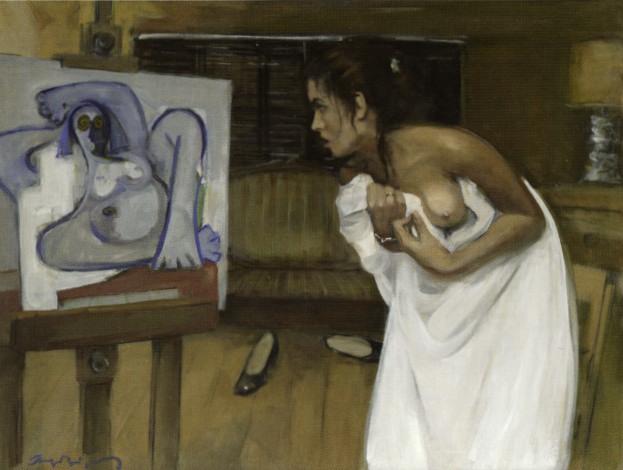
As a teasing introduction, though, here is a preview. This is one of the paintings we will be talking about. (This is NOT by Bachardy, but recently was on view in the National Portrait Gallery, London.)


I look forward to meeting my new friends in Santa Monica, and will be posting updates here on this site regularly. Until then, please look at your calendar and see if you can't come down next Saturday to introduce yourself and chat about writing, portraiture, hotel mirrors, or the desert versus the beach.

See you soon!

Charles Hood

Tuesday, November 20, 2012

The Beach House welcomes Charles Hood, 2013 Writer in Residence!


For the fourth Writer Residency at the Annenberg Community Beach House, the Beach House is proud to host author Charles Hood! 
Hood will be working on a series of fictional biographies currently titled Back Stories, based around the “orphaned portraits” of renowned Santa Monica painter Don Bachardy. Among the portraits Bachardy has made of the known and the beautiful (Tom Ford, Ginger Rogers, Henry Fonda), he also painted sitters whose identities are now lost — a friend of a friend of a friend, a surfer he met on the beach, an amateur model. Hood’s project weaves a fictional history for these unnamed sitters, welcoming them back to the common narrative. 

A Los Angeles native, Charles Hood has been a dishwasher, a factory worker, a ski instructor, and a nature guide in Africa. He attended Glendale College, Cal State Northridge, U.C. Irvine and the University of Utah, and also did Fulbright work in New Guinea, translating tribal poetry. For birdwatching, photography, or writing research, he has been to the South Pole (on a National Science Foundation Artists and Writers Grant), to each of the continents, and most of the way to the North Pole. His ninth book won the Hollis Summers poetry prize and will be released this spring by Ohio University Press; his eighth book, 25 Tigers, came out last month. His current projects include a survey of the Solar System titled 200 Moons, and a meditation on faith and history titled Melville in the Holy Land. Hood teaches writing, photography, and journalism at Antelope Valley College. He lives in Palmdale with a wife, a cat, a dog, two kayaks, and five mountain bikes.
Hood’s tenure begins November 26th 2012 and he will be working in the Marion Davies Guest House through February 4, 2013. All are welcome to stop by to ask questions and discuss his (or their) work during public drop-in office hours weekly from 11am-2pm: currently Sat 12/1, Sat 12/8, Thu 12/20, Sat 12/22, Sat 12/29, Sat 1/5, Sat 1/12, Sat 1/19, Sat 1/26, and Sat 2/2. Please check the blog for updates, including schedule changes.

His first public event is a conversation with Don Bachardy at 6:30pm on Monday, December 3rd. Make reservations at http://annenbergbeachhouse.com/beachculture.

He will also be conducting writing workshops on January 14 and February 4 - more info at the link above.